A new hope

Although there’s a mountain of candidates, that’s not to say there haven’t been any promising leads. Earlier this year a team led by the Liverpool School of Tropical Medicine, and including chemists from Imperial College London, announced the discovery of a fast-acting, and highly effective compound. I’m not a chemist, or even a chemical biologist, but I think the drug discovery process is fascinating. The team took the initial ‘hit’ molecule and used it as a starting point to design an effective drug candidate (a process called lead optimisation). They derived a quinazoline, with a central core of two carbon rings fused together, and from this an azaquinazoline (i.e. modified to replace a carbon atom with a nitrogen atom).

The drug was modified further, including the addition of a trifluoromethyl group (see below, the side group with three fluorines and a carbon). Quinazoline derivatives such as this are often used to fight malaria and cancer; in this case the modifications made the drug more potent, and they called it AWZ1066S.

The trail of derivatives used to find AWZ1066S.
Image credit: Figure 1 from the paper by Hong et al. is licensed under CC BY-NC-ND 4.0

It meets the main criterion: it’s fast-acting, and treatment over a week leads to Wolbachia depletion of over 90%. This stops the worms from producing microfilaria, but the macrofilaricidal effect in humans is only predicted; it needs to be confirmed in clinical trials. Currently, the drug is in preclinical testing, to see if to see if it is safe for trial in humans.

Looking at the figure below, we can see that AWZ1066S is able to kill the majority of Wolbachia within just one day, an astonishing performance. The fact that it does this so much faster than other treatments suggests something profound: that it has a completely unique mode of action, a ‘first-in-class’ drug.
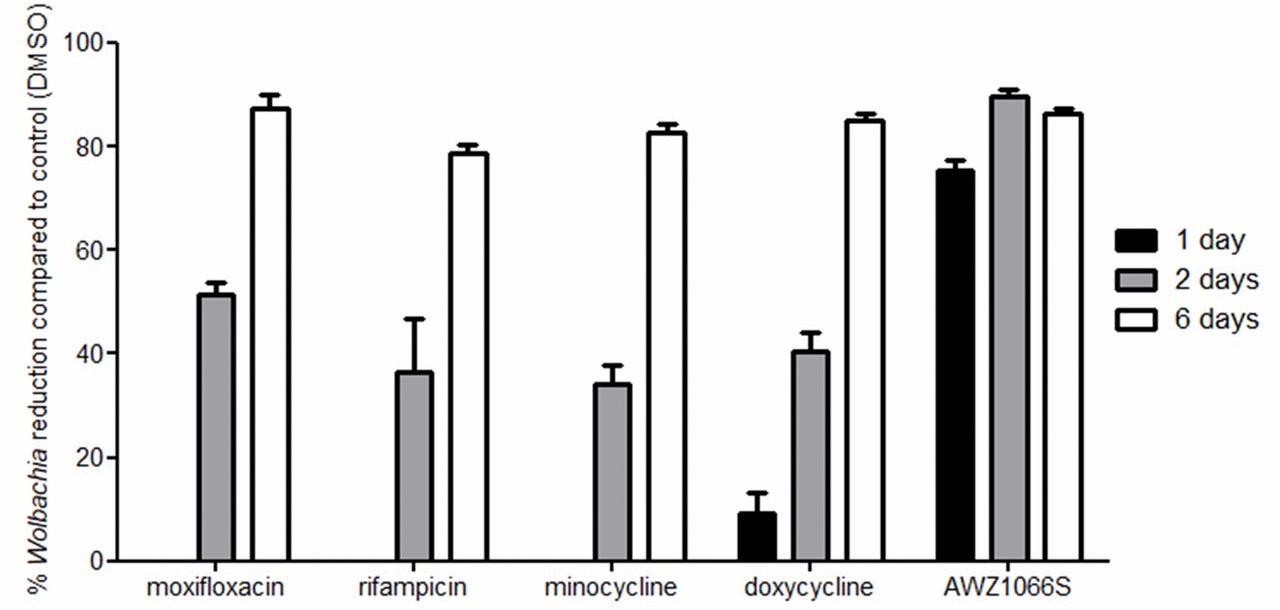
AWZ1066S outperforms all other treatments by a country mile.
Image credit: Figure 3 from the paper by Hong et al. is licensed under CC BY-NC-ND 4.0

This means that the drug will act fast enough to thwart bacterial resistance and, perhaps more importantly, the mode of action could be adapted to fight other bacteria. The trouble is, we don’t know what AWZ1066S targets in Wolbachia.

I asked Professor Ed Tate, from the Department of Chemistry at Imperial, and who led the work there. He’s also director of the Imperial Centre for Drug Discovery Science, responsible for “nucleating critical mass within the College” in the design of novel drugs—a rather curious mission statement, but of undeniable importance. He said:

“Knowing the target might let us ‘hop’ to the same target in other bacteria. If the target is novel then this could open up new ways to treat antimicrobial resistance in general. However, target identification in Wolbachia is very challenging thanks to the limited molecular cell biology and genetic tools available to undertake.”

The team did use chemical probes to identify some potential targets of the drug, but the problem still looms large: we don’t know how it works. Prof Tate says that finding this out would help determine “the risk of off-target effects both in humans and on other bacteria, and would help us make backup candidates in case the first drug meets problems in the clinic.”

Another boon to AWZ1066S is that it’s highly selective. This is a big advantage as the drug won’t kill the friendly gut bacteria, which play important roles in humans and other mammals. For example, Clostridium difficile is a commensal found in the gut (that is, they derive a mutual benefit from their hosts). They produce a compound called butyrate, which reacts with oxygen to produce carbon dioxide, lowering the oxygen concentration in the gut and making it harder for some harmful bacteria (which rely on the oxygen) to survive.

This is illustrated below: if an antibiotic (such as doxycycline) has off-target effects, these gut commensals may well be killed off, removing this very important line of defence. In these circumstances, nasty bugs gain the upper hand leading to some unpleasant side effects.

The trouble with antibiotics that aren’t specific to their targets

The feature is so important, it was selected for from the start by ensuring that it killed only Wolbachia and not other common gut bacteria. However, Prof Tate said “we do not currently understand whyit is selective, because we have not yet understood the mechanism by which it works in the bacterium”. He goes on to explain that it could be due to a variety of reasons, including selective uptake and accumulation, different metabolism, or a particular version of a common protein that’s particularly susceptible to the drug in Wolbachia.

So, there you have it. A very promising look at just one of the candidates which might one day help rid the world of elephantiasis. After a shockingly long history of this disease in humans (an ancient Egyptian statue of Pharaoh Mentuhotep II, who ruled over 4000 years ago, features the characteristic swelling), we are on the brink of its elimination. On behalf of the millions of people who suffer from the disease today, I can safely say it won’t be missed.

Target: elimination

In an earlier post, I outlined WHO’s goal to be free of elephantiasis by 2020. Global elimination efforts currently rely on multiple rounds of mass drug administration, where doses of medicine are given to entire populations on an annual basis. This is preventative treatment (controlling the spread of parasites), and has worked quite well, as we have seen. In the past, the recommended regimen involves a combination of two antibiotics that target the larval stage, diethylcarbamazine and albendazole.

They are capable of clearing almost all microfilariae from the blood, but come with some unfortunate side effects including fever, headache and dizziness. Making matters worse, the adult worms are long-lived. To break the transmission cycle by killing only larvae requires prolonged drug delivery with extensive coverage; hardly ideal in countries where resources are scarce. Instead, drugs that target the adult worms are desperately needed.

I’ve talked about how the worms rely on their bacterial symbionts for survival, making Wolbachia an obvious target in the elimination of elephantiasis: if you stop the bacteria, you also kill the worm. This has been demonstrated with doxycycline, an antibiotic which belongs to the tetracycline family of antibiotics. These work by binding ribosomes, an important cellular factory, thereby stopping the bacteria from making proteins and reproducing.

Ball-and-stick model of the doxycycline molecule, a tetracycline antibiotic.
Image credit: “Doxycycline 3D ball” by Jynto is licensed under CC0 1.0

Crucially, doxycycline is more effective than the combined treatment, and has none of the problematic side effects as it eliminates the adult worms. Through this novel method of targeting the symbiont, treatment reduces the level of Wolbachia to a level where adult female worms became infertile: a safe, macrofilaricidal treatment.

Doxycycline is the best drug treatment we have, but it has two standout problems: it can be harmful to children and pregnant women, and it takes at least four weeks to work. But, since the drug concept has clinical evidence to support it, the idea has taken off. The initiative was granted funding from the Bill & Melinda Gates Foundation, giving rise to the Anti-Wolbachia Consortium, A·WOL. Their headquarters are at the Liverpool School of Tropical Medicine, and you can see the team in the video below, squashing mosquitos:

Infected abroad: Mosquito Bites by AWOL Wolbachia

The real goal here is to find a treatment which clears infection in under a week. To this end, A·WOL has screened over 2 million compounds, an onerous task. They’ve since identified 20,000 candidates, all active against Wolbachia, and ready for further investigation. That’s pretty much where we are today, with people in lab coats wading through a pile of ‘drug-like compounds’ in search of something that meets the criteria.

The worm and the bacterium

Wolbachia is a group of bacteria, perhaps the most abundant reproductive parasite in the world. I first heard about them in my final year studies: we were talking about how bacteria are able to manipulate the hosts they infect for their own benefit, and how Wolbachia will dictate whether mating between their insect hosts is successful or not. This was first discovered in the 70s, when scientists at UCLA found that the sperm of infected mosquitos killed the female’s eggs. The phenomenon is called cytoplasmic incompatibility because the bacteria reside in the cytoplasm (the material within a cell). This helps the bacteria to spread through a population of insects, advancing at a rate of up to 100km per year.

Cytoplasmic incompatibility in mosquitos.

Indeed, Wolbachia probably rely on their hosts for survival, as you can’t grow them by themselves. They live in symbiosis with an amazing range of insects and other invertebrates. That is to say, they have an intimate and often interdependent relationship with their hosts. They fit into this story because they also live in symbiosis with the filarial worms that cause elephantiasis. They exist within the parasites that infect humans, creating a bizarre Russian doll situation. As a side note, there is fairly recent evidence that Wolbachia rely on a virus inserted within their own genetic code, to bring about the cytoplasmic incompatibility mentioned previously. Four levels of nested interaction make for a pretty intricate system, by anyone’s estimation.

Regardless, the worms themselves rely heavily on Wolbachia: without their symbionts they very quickly become sterile and die. In studies where antibiotics were used to kill the bacteria, filarial embryos were severely deformed, suggesting that the bacteria are essential in the early development of worm offspring.

Transmission electron micrograph of Wolbachia within an insect cell.
Image credit: “Wolbachia” by Ayacop is licensed under CC BY 2.5

They are also needed for proper regulation of apoptosis, a kind of controlled cell death. Without Wolbachia there is a dramatic increase in apoptosis(and sterility), demonstrating that host and symbiont have coevolved so that this particular aspect of regulation is outsourced (with dire consequences if the symbiont is absent). This is both true for cells of the body, and those of the germline (the cells that pass on their genetic material to offspring). In fact, Wolbachia actually live inside the germline cells of their hosts, and have the amazing peculiarity of being transmitted by the host female germline to offspring, like mitochondria are in humans.

Through this process, called vertical transmission, the Wolbachia have become master manipulators of their hosts to make sure they’re passed on to the next generation. The worms depend on Wolbachia in the germline for two reasons: they maintain a level of dormancy, ensuring a steady stream of egg production for many years, and they encourage the cells to proliferate. This is a rare example of developmental symbiosis, but the obvious application of this knowledge is to target the bacteria and kill the worms indirectly, something I will come onto next.

Life as a filarial nematode

When an infected mosquito lands on a host and takes a blood meal, filarial larvae are deposited on the skin surface. They find their way through the bite wound and migrate to the lymph nodes, where they develop into adults. Once they have reached sexual maturity, they reproduce over their extensive lifespans to make millions of microfilariae (immature larvae) that circulate in the blood.

The human stage of the nematode life cycle comes to an end when another mosquito takes its blood meal, drawing up the immature larvae. The tiny worms have to be pretty quick about getting in position because, unlike their parents, they only live for a few months to a year. The microfilariae then burrow through the wall of their host’s midgut, to reach the muscle groups below. Here they mature into infective larvae, and migrate to the mosquito’s proboscis (the elongated sucking mouthpart) ready for transmission.

Life cycle of a filarial nematode.

I’ve never studied parasite biology, but I find it really interesting. This life story in particular raises an important point: the worms reproduce sexually, so the host must have both male and female parasites to support a productive infection. Accordingly, years of exposure are required before serious disease can develop in the human host. However, the worms are patient, and adults will live for up to 8 years while they wait for a mate…

What can we do about it?

Elephantiasis is an NTD: a neglected tropical disease. Although I think that the term falls victim to a desire in the sciences to give every concept a snappy abbreviation, this particular term encompasses a diverse array of nasty diseases, of which elephantiasis is the oldest known and most debilitating.

In light of this, the World Health Organisation (WHO) launched a global elimination programme in the year 2000, with the target completion date set for 2020. I’ll go into further detail in a later blog post, but in essence, the programme consists of large-scale preventative treatment in high risk areas, to complement direct treatment of those infected. It’s a colossal effort, but WHO claims that annual treatments over a period of 5 years will displace the disease from any given area. In aid of this, nearly 7 billion treatments have been handed out since 2000. That’s a staggering number.

To see how effective it has been, let’s look at the numbers: when the programme began there were more than 120 million people infected, and this has since declined to just under 40 million (the latest estimate); a considerable drop of about two thirds. Still, there are 900 million people who remain at risk, so committed nations need to keep up the pressure. These figures also make the target date of 2020 seem rather unrealistic, although WHO maintains that, by then, every single country where elephantiasis is commonplace will be free of transmission (or at least in post-intervention surveillance). So there is hope, not least because of a growing arsenal of anti-filarial drugs: stay tuned for when I talk to one of the scientists spearheading this work.

So, what is elephantiasis?

I became interested in this disease because of its symptoms, which are truly unmistakable. You may be familiar with the painfully enlarged body parts—the bulbous limbs defying all sense of proportion—which cripple the patient both physically and with a heavy social stigma. Rather than give a blow-by-blow of the disease’s history and symptoms in excruciating detail, in this blog I want to look at some of the particular aspects that interest me. As you will see, there are some striking features of the disease and its treatment, which deserve special attention.

Image credit: “‘‘Elephantiasis’ of the legs of a woman” by is licensed under CC BY 4.0

Firstly, some context: people are usually infected during childhood, when a parasite finds its way from a mosquito into a human host. These parasites are roundworms, otherwise known as nematodes. They are very diverse and, quite remarkably, have adapted to pretty much every environment on the planet; you will find them deep beneath the Earth’s surface and on mountains, in the polar extremities as well as the tropics. To demonstrate just how widespread they are, I like this quote from Nathan Cobb, dubbed the father of this field in the US:

“In short, if all the matter in the universe except the nematodes were swept away, our world would still be dimly recognizable, and if, as disembodied spirits, we could then investigate it, we should find its mountains, hills, vales, rivers, lakes, and oceans represented by a film of nematodes. The location of towns would be decipherable, since for every massing of human beings there would be a corresponding massing of certain nematodes. Trees would still stand in ghostly rows representing our streets and highways. The location of the various plants and animals would still be decipherable, and, had we sufficient knowledge, in many cases even their species could be determined by an examination of their erstwhile nematode parasites.”

But I digress. The worms causing elephantiasis belong to a certain family called the Filariodidea (hence the term filariasis). I’ll describe the parasitic life-cycle in a later blog post, but suffice it to say that the adult worms lodge themselves in the lymphatic system, an extensive network of vessels that carry a clear fluid called lymph. This network is important for two reasons: it returns plasma in the interstitial fluid (which bathes the cells of the body) back to the bloodstream, and it has a critical role in the immune system. It carries white blood cells called lymphocytes, which attack and break down bacteria, viruses and cells that are damaged or cancerous.

Image credit:Wuchereria bancrofti by Eleassar is in the public domain

When the network is blocked by parasites, fluid builds up to produce the characteristic swelling. In cases of elephantiasis, the disease progresses so that the skin thickens and takes on the appearance of elephant limbs. Swelling of the scrotum is also common (a condition called hydrocele), and these features lead to social stigma and depression.

Given that the lymphatic system is an important in fighting disease, it’s no surprise that elephantiasis is often complicated by secondary skin infections. These acute episodes are particularly unpleasant, and are the main reason for loss of wages and quality of life. This all makes for a particularly nasty tropical disease, one which has troubled humans in tropical countries for millenia.